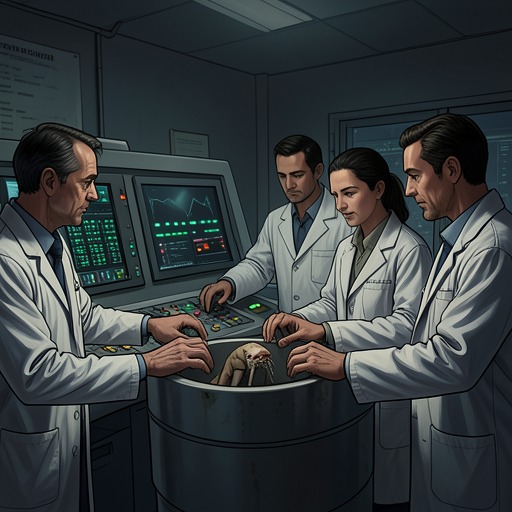
Stanley Frost
The SwarmStanley Frost is a volcanologist whose work on La Palma turns an apparent anomaly in the distribution of methane hydrates into a warning about a potentially unstable volcanic flank. He brings geological expertise to the investigation of the worms, then helps organize an ambitious effort to remove them from the seabed. When the operation encounters an obstacle that its robot cannot clear, Frost chooses to dive himself; he dies during the attempt, making his willingness to act on his own assessment part of the mission’s cost.
Identity and Geological Perspective
Frost approaches the crisis through the structure and history of the seabed. Energy-industry surveys had charted methane-hydrate deposits across numerous regions, including the Pacific, the North Atlantic, the Caribbean, the Mediterranean, and waters off Norway. Yet the charts showed few deposits near the Canary Islands. Frost regards that absence as suspicious rather than conclusive: the islands’ steep volcanic slopes could send sediment and organic matter downwards without allowing it to accumulate where conventional surveys would expect to find deposits.
His alternative account is geological and specific. The volcanic peaks rise from depths of roughly 3,000 to 3,500 metres, but, he argues, the submerged slopes need not be smooth or sheer. Ridges and terraces could trap sediment, while hydrates might run through the rock in thin veins rather than lie in conspicuous seabed deposits. Because Frost is a volcanologist rather than a hydrate specialist, he seeks Gerhard Bohrmann’s help, combining his knowledge of volcanic formation with Bohrmann’s expertise in methane hydrates.
La Palma and the Threat Beneath the Island
Frost draws up a list of volcanic islands that may be at risk: La Palma, Hawaii, Cape Verde, Tristan da Cunha, and Réunion. He considers La Palma the most serious case, with the Cumbre Vieja ridge presenting a possible danger to millions of people. This is a forecast, not an established outcome, and the distinction matters: his concern rests on geological evidence and a proposed chain of events whose timing cannot be known with certainty.
His account of the western flank begins with the 1949 eruption. An eruption at the top of the San Juan volcano opened a fault running for kilometres along La Palma’s western side, and a section of the ridge slid four metres towards the ocean. Frost says he has monitored the region for years. In his assessment, groundwater trapped within the rock could intensify pressure when new magma enters a volcanic vent: water could expand rapidly, potentially helping to blast the already destabilized flank into the sea. He estimates that a collapse could involve about 500 cubic kilometres of rock. The Canary Islands authorities regard the theory as dubious, but Frost’s monitoring and his proposed mechanism give his warning a concrete basis rather than leaving it as a general fear of volcanic disaster.
The location of the worms sharpens his concern. Frost asks why worm activity has become conspicuous near a holiday island when larger human populations and hydrate deposits exist elsewhere. His reasoning brings the organisms and the island’s geological vulnerabilities into the same frame: the volcanic landscape is not a picturesque backdrop but a system with a history of eruptions, faults, and instability. The possibility that the worms’ presence relates to those vulnerabilities makes their removal seem urgent, even as the scale of the geological danger remains uncertain.
From Assessment to Removal
With Bohrmann’s support, Frost and his team obtain the research vessel Polarstern for an expedition. It carries a Victor 6000 and is fitted with underwater cameras intended to detect invading organisms, including worms, mussels, and jellyfish. The robot’s descent gives Frost a way to test his suspicions directly. Off La Palma, it searches the steep volcanic face and finds overlapping terraces at a depth of 400 metres, their surfaces covered with sediment. The observation supports his contention that the submerged slopes have features conventional charts might miss.
Frost’s response to the wider threat is practical and forceful. At the later operation, the team sets up a suction tube and a separate lighting-and-camera unit, lowered by two cranes. The lighting structure is a large, collapsible scaffold carrying lights and cameras; technicians coordinate the equipment from elevated control positions. Frost celebrates the system as a deep-sea vacuum cleaner for worms and presents La Palma as a manageable first target, while looking ahead to other threatened volcanic islands. He has also sent a robot towards Hawaii, where the southeastern flank is reported to be swarming with worms. His confidence in the removal plan is tempered by Bohrmann’s concern that bacteria may already have been deposited in the ice and that removing the worms may not prevent Cumbre Vieja from collapsing.
Frost’s manner combines technical urgency with theatrical encouragement. He invokes divine blessing for the work, praises the De Beers Corporation technicians, and frames the effort as a campaign against an enemy. The speeches help rally the team, but they also contrast with the limits Bohrmann keeps in view: clearing one area cannot resolve the larger uncertainty about what the organisms have already changed, or whether the volcanic flank can still be stabilized.
The Dive and Its Cost
When the robot Rambo repeatedly fails to dislodge a rock, worms begin to spread back across the area the team has cleared. Bohrmann warns that the location is especially unstable. Frost decides to take a dive himself, reasoning that if the robot cannot remove the obstruction, people will have to do it. He judges the pressure suits capable of reaching the depth, about 400 metres. His choice moves him from directing the operation to taking personal responsibility for its most hazardous task.
Frost proposes bringing an explosive charge. Bohrmann objects, and Frost backs away from proceeding on that basis; he nevertheless persuades Bohrmann to join the dive, pointing to the need for two strong men and dismissing the objection with an attempt at reassurance. Their exchange shows both Frost’s improvisational decisiveness and the tension between action and caution that runs through the operation. Frost’s resolve does not remove the danger posed by the unstable seabed or the animals encountered below.
During the dive, sharks attack. As Bohrmann watches, Frost attempts to fend one off, but the animal tears away part of his suit and fatally injures him. The smaller sharks then turn from Bohrmann towards the disturbance around Frost. The scene indicates that whatever influence may be directing animal behavior does not wholly suppress the animals’ own predatory instincts. Frost dies underwater, before the removal effort can become a solution to the larger threat he identified.
Narrative Role
Frost’s arc links observation to intervention. First he questions the charts, then interprets the terraces and faulted volcanic flank, and finally helps turn those assessments into a large-scale engineering response. Each step makes knowledge consequential without making it omnipotent: the expedition can reveal sediment-covered structures, and the suction system can be built, but neither guarantees control over the worms or the geology beneath La Palma.
His death is therefore more than the loss of an expedition leader. The man who has spent years monitoring the island’s dangerous flank enters the deep environment where his plan must be tested, and the mission’s tools prove unable to make that environment safe. Frost’s confidence and urgency remain important to the effort, but the outcome preserves the uncertainty at the center of his warning: recognizing a threat, and acting against it, do not necessarily mean that it can still be contained.